
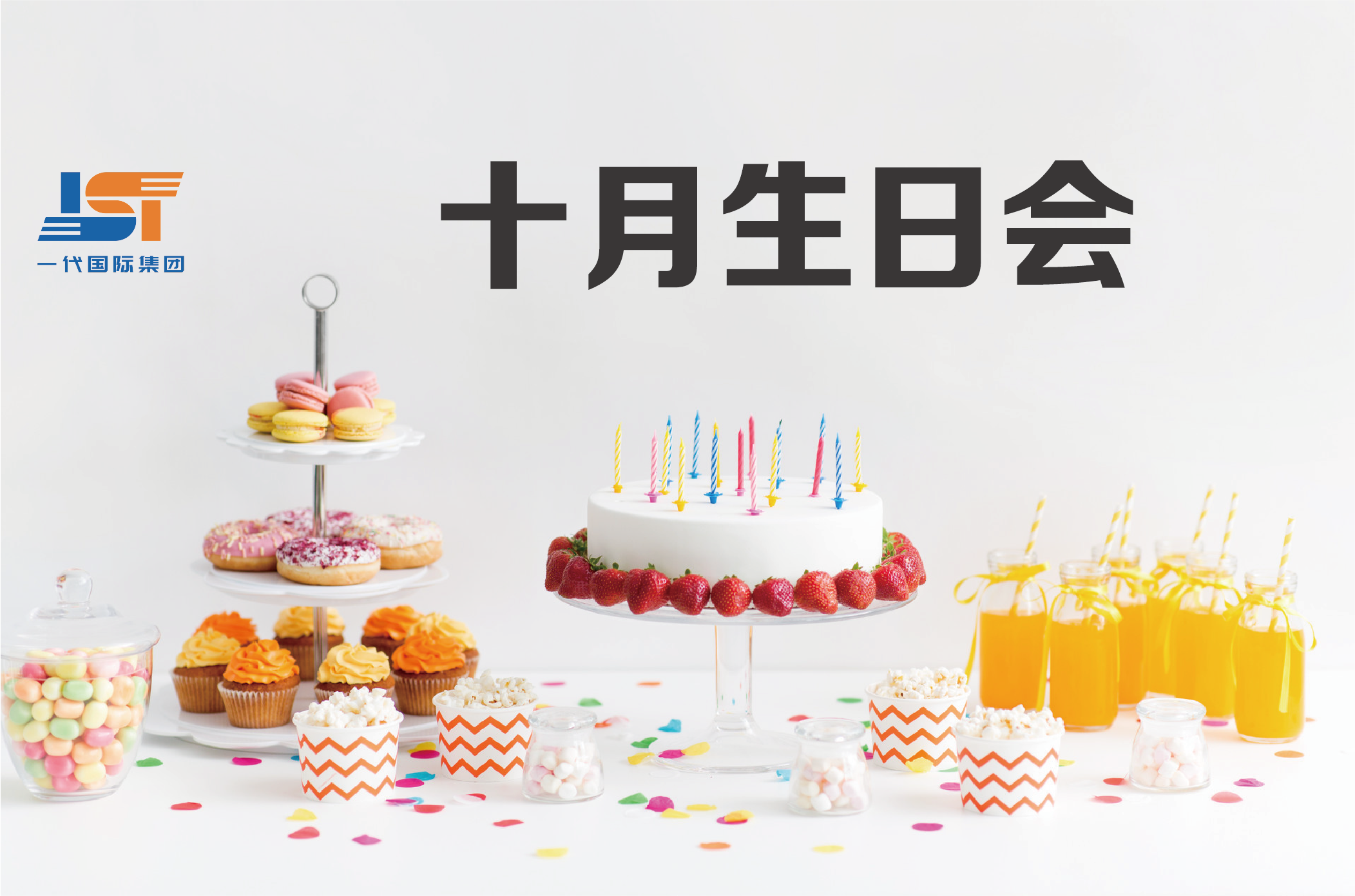
October birthday pa...
2022-10-29
May you bravely go to the next year! In the days to co...
On May 12th, China and the United States issued the "Joint Statement of the China-Us Economic and Trade Talks in Geneva", agreeing to take measures to significantly reduce bilateral tariff levels by May 14th, 2025. On the evening of the 13th, in the warehouse of Cuigang Industrial Park in Huaide, Fuyong, Bao 'an District, Shenzhen, which is 9,472 kilometers away from Geneva, Switzerland, workers worked in perfect harmony, quickly sorting various goods, classifying, packaging, labeling and loading them onto vehicles... One by one, large trucks fully loaded with goods are all set to go. Meanwhile, Ling Hushun, the founder of Shenzhen Yidai International Logistics (Group) Co., LTD., is busy calculating the logistics costs and tax rates after the tariff reduction between China and the United States, in order to promptly feed back to the upstream cross-border e-commerce enterprises. "Yesterday (the 12th) alone, we received around thirty or forty clients." The most frequently asked question by upstream cross-border e-commerce enterprises is what the new logistics costs and tax rate composition of the corresponding export products will be after the mutual tariff reduction. Ling Hushun said that since yesterday, he and his team have been busy communicating closely with upstream cross-border e-commerce enterprises, informing them of the latest logistics costs and budgets so that the upstream e-commerce enterprises can adjust the pricing of their products at the front end. Meanwhile, the back end also needs to maintain communication with the customs declarants in the United States to understand the real-time tax rates and the status of the entire customs declaration and clearance system. Entering the warehouse of this e-commerce logistics enterprise, various cross-border goods are neatly arranged by category, among which there are also many overstocked products that have been asked to postpone their shipment recently. Staff members are sorting, boxing and packing packages of all sizes out of the warehouse in an orderly and tense manner. The sound of tape being torn and pulled can be heard one after another. Outside the warehouse, transport vehicles are all set to go. As soon as the announcement of mutual tariff reduction between China and the United States was made, Ling Hushun received many messages from old customers that they would postpone their shipments. For e-commerce sellers exporting to the United States, the price difference caused by the tariffs before and after is very large. They hope to wait until the tariffs are truly reduced before shipping to ensure that the latest tariff policies are implemented upon arrival in the United States. Therefore, there is currently a certain amount of backlog in the warehouse. Ling Hushun predicted that after the 14th, there will be a "small peak" in the shipment of goods to the United States, which will bring new challenges to cross-border e-commerce logistics. "As soon as tariffs are reduced and enterprises hope to send out goods as soon as possible, whether the warehouse space is sufficient, whether there will be some fluctuations in prices, and the smoothness of the entire logistics transportation chain are all full of tests." Ling Hushun admitted that the reason why enterprises have been able to maintain an optimistic attitude and a "calm" stance in the current Sino-US tariff storm is, on the one hand, that the high quality, high cost performance and mature and efficient supply chain of "Made in China" cannot be replaced in the short term. On the other hand, it lies in the fact that enterprises have learned to build their own "moat" in adverse circumstances. He said that in recent years, the company has increased its investment and established its own logistics brand, 3PE Express, in New York, USA, specifically providing economical express delivery services for Chinese cross-border e-commerce sellers and brands going global and other customers.
Copyright Ist International Logistics (Group) Co., Ltd. All rights reserved.Company License


 0755-29778100
 Building 36, zone 5, Huaide Cuigang Industrial Park, Fuyong street,
 Bao'an District, Shenzhen